


Sub-Total: £0.00
The Pragmatic Aquarist
I Wanted to Stock This Pond Product. Then I Looked Closer.
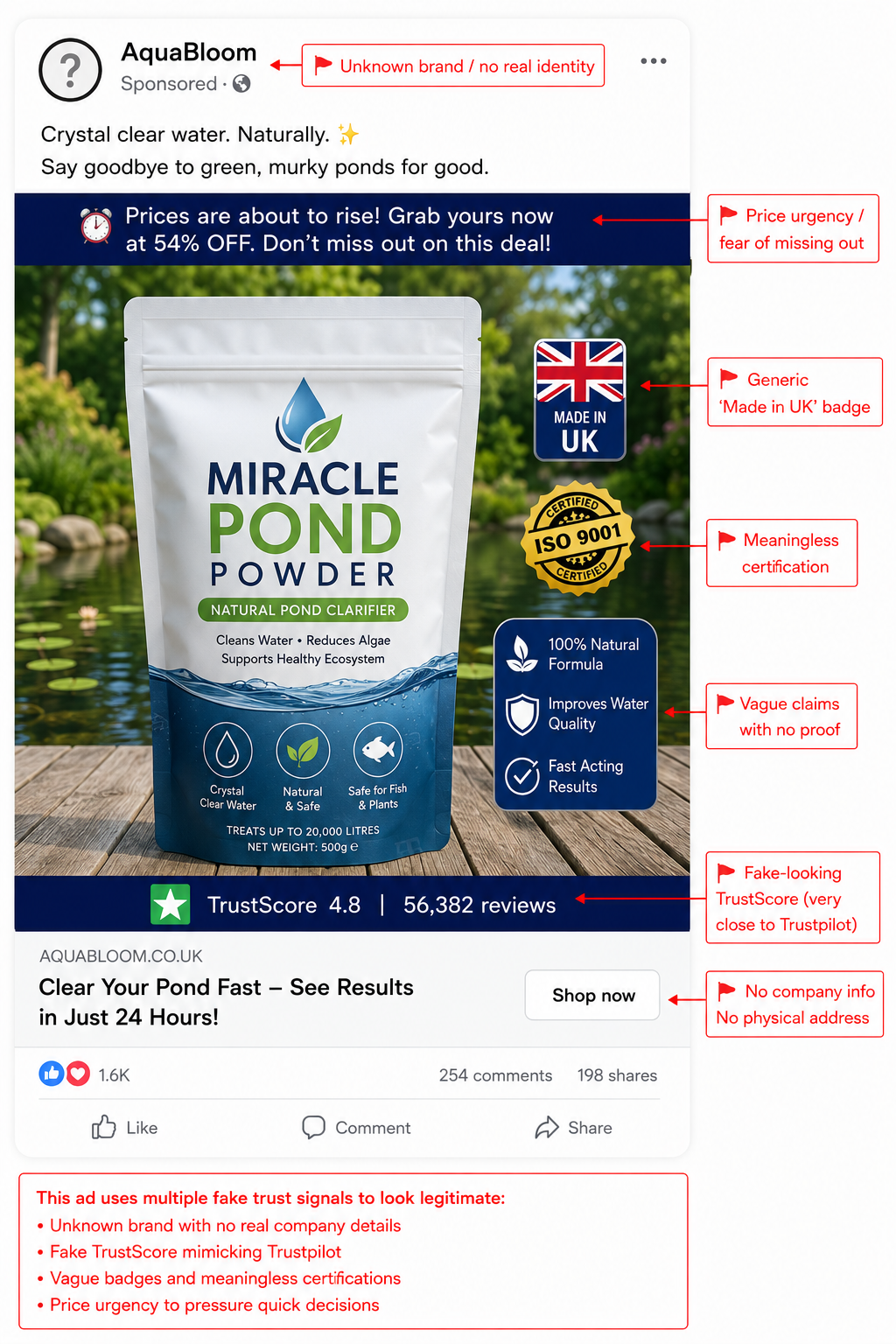
You've probably seen the advert. A glossy before-and-after image of a swamp-green pond turning crystal clear. A bold promise: clears your pond in 24 hours, guaranteed. Thousands of glowing reviews. Professional branding. Everything about it says this is the real thing. These are the fake pond product adverts filling Facebook right now, and they are very convincing.
I'll be honest with you. I wanted to believe it too.
When I first saw these adverts, I didn't dismiss them. After 35 years in this business I know that genuine breakthroughs do come along occasionally, so my first thought wasn't "that's a scam." It was "who makes this, where can I get it, and can I put it on the shelves at Shirley Aquatics for my customers?" The trust signals were good enough that I was ready to stock it.
It was only when I started digging a little deeper that the whole thing fell apart. What I found wasn't encouraging, and I think you deserve to know what to look for.
Watch: my own look at these pond product adverts and why they don't add up.
First, What Actually Is a Trust Signal?
My wife Sarah asked me this exact question, so let's not assume everyone knows the jargon.
A trust signal is anything that makes you believe a business is real, credible, and safe to buy from. They're everywhere, and good ones work because they're based on genuine, checkable things.
You'll see ours all over this website. Established 1939. Real Google reviews from real customers. A shop you can walk into and a person you can stand in front of. Every one of those I can back up. They're quantifiable. You can check them yourself, and I'd encourage you to.
Here's the uncomfortable part. The scammers understand trust signals better than most honest businesses do, because manipulating them is their entire job. They know exactly which buttons to push, because they're the same buttons legitimate companies use. A review panel that looks like Trustpilot. A "Made in the UK" badge. A confident expert in a white coat. They want it to look real because they know you want it to be real. You're tired of green water, and you're hoping this is the answer.
The difference is simple. When you delve into a genuine trust signal, it holds up. When you delve into a fraudulent one, even just a little, it falls apart almost straight away.

Thirteen Pointers That Should Raise Your Alarm Bells
Here's what I've learned to look for. You won't always see all thirteen, but if two or three of these show up together, keep your hand away from your wallet.
- The reviews multiply or change. Check the advert again tomorrow. The comment count will have shifted, negative feedback will have quietly vanished, and a lot of the glowing comments read as though they were written by the same person, because they were.
- The before-and-after images and videos are fake. I use AI every day to save time in the business, so I've nothing against it. That's exactly why I know how convincing these fakes have already become. Watch one of these videos and a pond goes from a cesspool to a swimming pool in seconds, or the fish appear to be swimming in thin air. Look closely at the water, the reflections and the edges and the tells are there. And here's the uncomfortable part: these images are only going to get more realistic and more advanced as time goes on. If they can't show you a real, photographed result, ask yourself why.
- The credentials lead nowhere. PhDs, universities, laboratories, certifications. Try to verify any of it and the people don't exist, the institution never said it, or the "research" is about something else entirely. Honest companies are happy to be checked.
- The company can't be found. No address you can look up. No phone number you can ring. Nothing on Companies House. Just a vague "Made in the UK" badge and a contact form that leads nowhere. A real business is findable.
- The guarantee sounds perfect but isn't. "100% money back, no questions asked." Then the small print makes a refund almost impossible to claim. Real guarantees are simple to read and simple to use.
- There's fake urgency. Countdown timers that reset when you reload the page. "Only 3 left in stock." "Sale ends midnight." It's designed to rush you past the doubts you'd otherwise listen to. Genuine retailers don't need to panic you into buying.
- The demonstration is a jug, not a pond. They drop the powder into a glass of murky water and it clears in seconds. But a jug has no fish, no circulation, no biology, no 5,000 litres of living water doing its own thing. The chemistry in a glass does not scale to a real pond, and they know it.

A jug is not a pond. - The payment feels off. You're pushed towards a checkout with no buyer protection, an odd payment method, or a page that doesn't look like it belongs to the brand. The gentleman I mention below was charged twice for a single order. If anything about paying feels wrong, stop.
- The product itself gives the game away. When it finally arrives, the packaging is cheap, the wording on the back doesn't match the advert, and the powder looks like sugar. That sinking "I've been had" feeling is usually correct.
- Read the comments properly. Scroll down under the advert and you'll often find genuine people asking real questions. How do I use it? Will it harm my fish? It hasn't worked, what do I do now? Watch how they're answered. Mostly the reply is some version of "buy more." Requests for actual instructions tend to go unanswered completely. A real company helps its customers. A scam just wants the next order.
- Does it even sound like an aquatics company? Ask yourself a simple question. Have you ever seen a real, established aquatics business advertising this product? If it's as miraculous as they claim, why isn't it on the shelf at your local fish shop? Then go and look at their Facebook or Instagram profile. The one I looked into had two photos on it and nothing else. A genuine expert who'd cracked pond care would have years of posts, advice and insight behind them. An empty profile tells its own story.
- Are you suddenly being chased round the internet? Show a flicker of interest and watch what happens. You'll start seeing the same product pushed at you by a parade of different companies you've never heard of, all with names you won't remember five minutes later. It's the same operation wearing different coats. One genuine product from one genuine company doesn't behave like that.
- And the oldest rule of all: if it looks too good to be true, it is. There is no one-size-fits-all with ponds, ever. A pond is a living ecosystem, and two that look identical can have wildly different water chemistry. Every pond clearer and algae treatment on the market, the honest ones included, needs your water chemistry to be within a particular range before it will do anything at all. A product that claims to work for any pond, every time, is quietly telling you it understands ponds less well than you do.


Tools Against the Dark Arts
Spotting the red flags is one thing. Here are three simple tests you can run yourself before you spend a penny. None of them costs anything, and between them they'll catch most of these out.
Check them against an independent source
This one is my wife Sarah's, and it's the first thing she does with anything we buy online. Don't rely on the reviews shown in the advert itself, because as we've seen, those can be faked to look like the real thing. Go straight to an independent site like Trustpilot yourself, type the address in rather than clicking their link, and search for the company or product by name. Independent scam-checking sites are worth a look too. Be sensible about it. Even these can be gamed, and a brand new company with no history isn't automatically dodgy. What you're looking for is a pattern. If real, unconnected people are reporting the same problems, listen to them.
Ask for the safety data sheet
Any genuine product that goes into water with living fish in it has a safety data sheet, sometimes called an MSDS. It's a standard document that tells you what's actually in the bottle. Email the seller and ask for it. An honest company will send one over without fuss. A scam operation will do one of three things: the email bounces back as unknown, it lands in a shared inbox that several different "brands" all seem to use, or you get an identical, oddly generic reply that's clearly been sent to everyone. This is one of the quickest ways to tell a real seller from a fake one, and almost nobody thinks to do it.
Screenshot it and ask an AI
Take a screenshot of the advert or the website, paste it into whichever AI assistant you use, and simply ask, "Is this a scam?" In seconds it'll often flag the same tells I've listed above: the AI imagery, the impossible claims, the missing company details. One honest word of caution, because I'd be a hypocrite otherwise. AI isn't gospel. It's a quick second opinion, not a final verdict, so use it to sharpen your own judgement rather than replace it. But as a thirty-second sanity check before you hand over your card, it's hard to beat.

Someone Investigated This Properly. Here's What He Found.
Shortly after I posted my video on this, a man got in touch. Forty years in the aquaculture supply industry. A former police officer and private investigator. A man, in other words, trained to spot fraud for a living.
The advert was convincing enough that he ordered some too.
The moment it arrived he knew, just from the packaging and the wording on the back, that something was wrong. When he went looking for the website he'd bought from, it had vanished. Checking his bank, he found he'd been charged twice for an order he'd only placed once. His bank refunded him, but only because he spotted it.
Then he did what a man with his background does. He went through more than a dozen of these adverts and the companies behind them. The same near-identical websites, the photographs simply swapped around. The same terms, privacy policies and contact pages, copied with only minor changes, and built so you can't even cut and paste a section of them. He checked Companies House and found the registered offices were business centres acting as mail-forwarding addresses, with single overseas directors and thousands of companies stacked behind one door.
I'm naming nobody, and the nationality of the people behind it isn't the point. The structure is the point. This is fraud at scale, deliberately built to be hard to trace.
And here's what stays with me. A man with forty years in the industry and a career spotting fraud was still convinced by this advert, because the trust signals were that good. If it can persuade someone like him, it can persuade any of us. That isn't a failing on his part. It's a measure of how sophisticated these operations have become. The fault lies entirely with the people running them.

Why There's No 24-Hour Fix for Your Pond
Here's the bit the scammers will never tell you. There is no single product that clears every green pond in 24 hours, and it's not because the science doesn't exist. It's because every pond is different.
Your water chemistry, your fish load, your filtration, your planting, your nutrient cycle: all of it is unique to your pond. Clear water and clean water are not the same thing either, and the products that genuinely help work on the cause of the problem rather than just the look of it for a day or two. Anyone promising a guaranteed instant fix for any pond isn't selling you science. They're selling you a fantasy, and counting on you wanting it badly enough not to ask questions.

So what is actually going to work for you? I'm sorry to say it, but there's no silver bullet and no magic pill that resolves your pond issues in the blink of an eye. What there is, though, is a lot of genuine products that will make a real difference to your fish, your pond, and ultimately your enjoyment of it.
If you like, you can take a look at some of these products on our website, or for that matter on any other reputable aquatic company's. Or if you'd rather, email me directly. I'm more than happy to point you in the right direction, whether you buy from us or not.
A Quick Word on Why This Article Won't Last Forever
I'll be straight with you. I may well be rewriting this piece in twelve months.
We're in an arms race. The AI imagery improves every month, the fake reviews get cleverer, the shell companies get harder to unpick. The line between what they want you to believe and what's actually true is getting harder to see, not easier. The specific tells I've listed today may not all work a year from now.
So treat this less as a fixed checklist and more as a way of thinking. Trust signals can be faked, so check the ones that matter. If something looks too good to be true, it almost always is. That principle will outlast any individual trick.

The Short Version
- I wanted to stock this product myself. It was only when I looked closer that it fell apart.
- Trust signals are what make you believe a business is real. Honest ones hold up when you check them. Fraudulent ones don't.
- Watch for multiplying reviews, fake AI images and videos, unverifiable credentials, untraceable companies, fake urgency, jug demonstrations, dodgy payment, cheap packaging, "buy more" comment replies, empty social profiles, and the same product swarming you under different company names.
- These thirteen pointers apply to anything you see advertised online, not just ponds.
- Three free tests catch most fakes: check independent sources like Trustpilot yourself, ask for the safety data sheet, and screenshot the advert into an AI assistant and ask if it's a scam.
- No honest product clears every pond in 24 hours, because every pond is different.
- If in doubt, ask a real shop. We're happy to help whether you buy from us or not.
If you've seen one of these adverts and you're not sure, come and talk to us. We've been doing this in the same shop since 1939, and you can always get a straight answer from a real person. And if you'd like the full breakdown of how these scams are put together, I went into it in more depth here: Are Pond Water-Clearing Products a Scam?
Richard Cook is the Managing Director of Shirley Aquatics, a family-run aquatics business that has been serving fishkeepers since 1939. A third-generation aquatic retailer with over 35 years of hands-on experience, Richard is the voice behind The Pragmatic Aquarist, known for his honest, no-nonsense approach to fishkeeping advice that helps customers make confident decisions that work in the real world, not just on paper.